
Fatherland Review
Fatherland (2026) Film Review, a movie directed by Paweł Pawlikowski, written by Henk Handloegten and Paweł Pawlikowski and starring Sandra Hüller, Hanns Zischler, August Diehl, Devid Striesow, Anna Madeley, David Menkin, Enno Trebs, Theo Trebs, Waldemar Kobus, Fritzi Haberlandt, Milan Peschel, Joanna Kulig, Christophe Falconnet, Giorgio Rayzacher, David L. Price and Bernd Moss.
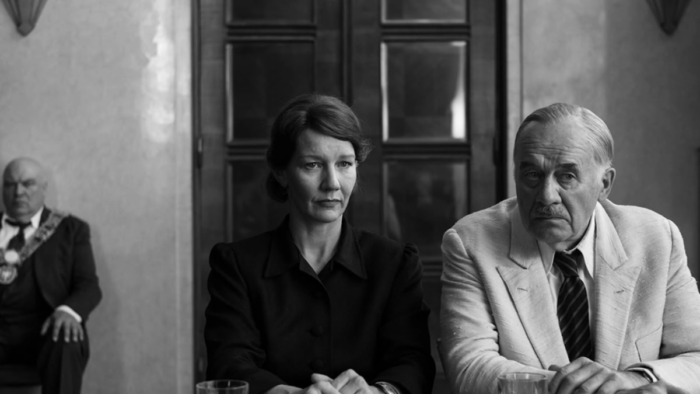
Filmmaker Pawel Pawlikowski’s third film in a Cold War-related series of dramatic movies is Fatherland. This new picture is a very interesting black and white picture about the dynamics of a woman thrust into the public eye while representing her writer dad. It’s a matter-of-fact portrayal of events that shape the structure of the picture, which eventually takes the time to explore not only the bond between the daughter and her dad, but also the both of them and the “other” child, who eventually is discovered to have taken his own life.
There’s silence during the funeral scene in the picture, and the movie is very intentional in terms of the way it presents the character of Klaus Mann (August Diehl), who we see at the beginning of the movie. He’s not in much more of the picture than that brief, defining scene, however. Klaus’s family includes his sister, Erika (Sandra Hüller), and their Nobel Prize-winning intellectual dad, Thomas Mann (the great Hanns Zischler). Klaus speaks to Erika on the phone as we see his male lover in the background as the film begins. Klaus is a tortured writer in a world that hasn’t always been kind to the complexity of his work.
In a post World War II Germany, Thomas is making his way around the country to answer questions regarding his distinguished writings on difficult and analytical subject matter. Erika is revealed to view her dad as a narcissist as he writes off Klaus as a substance abuser while ignoring the big picture. Erika is less well-received in the professional work she does than her father. They come together to bring Thomas’s viewpoints into view and to talk to reporters as he accepts the Goethe prize, but is Thomas more concerned with his work than his own family?
Erika expects Klaus to join her and their father on their tour, but Klaus doesn’t show up. Instead, we get to see the ways Erika and Thomas clash over their complicated viewpoints. Another question that viewers may ask could be: Is Thomas consumed by his work and neglecting the bigger picture for a particular reason, or is his work actually meaningful and able to change the world?
This film digs deep inside the way Thomas was ultimately able to shape his work by avoiding Nazism. A two-hander develops as Thomas and Erika are left to deal with the consequences of the heart-wenching decision that Klaus is found to have made regarding his life. Besides keeping the intensity of the complex politics of the film intact, the movie focuses on the two main characters and the performances are quite strong.
Hüller projects sadness as she develops the poor way that Erika has steered her life away from her larger goals due to the lack of acceptance from the world. Zischler develops his character convincingly, and it’s, quite possibly, an awards-worthy supporting performance.
While Hüller gets the showier scenes and has stronger dialogue, the way that Thomas develops is more fascinating the more the film goes on. This is not a long film, clocking in at a mere 82-minutes with closing credits. It’s a slice of the dark side of life in a family that knew how to present complex ideas to the world more than anything else.
Diehl has a memorable scene at the start of the film, talking on the phone to Erika, but isn’t in the movie for a lot more on-screen development. Yet, his brief opening sequence says enough about the character to make the audience interested in the fate of Klaus, and how his demise affects the family dynamic and the world as Klaus’ work receives further exposure after his parting.
Fatherland could be titled as it is to refer to the ever-changing world that Erika finds herself immersed in. While everything revolves around her dad, Erika struggles with finding her acceptance of Klaus’ fate and even her own fate regarding what she wanted to do with her iife versus what she is actually doing with it.
If some scenes work better than others, the consistency of the viewpoints displayed and the complex political themes the movie offers its audience makes Fatherland a very impressively constructed little film. Hüller is having a great year at the movies although she doesn’t get to achieve here the levels of acting which she displayed in her other major film this year, Rose.
Fatherland puts its main characters under a microscope for all to see. As the spoken language varies between scenes, the movie grows intensely the more it moves along. It’s the type of movie that demands a second viewing because of the way it doesn’t let its characters become victims of their individual situations. Set in the late 1940’s, that time period is given a polished presentation that makes the setting and those circumstances surrounding it a character in and of itself.
In the end, Fatherland is a historical drama like no other. Lessons are learned and characters are defined by their thoughts and actions. One may question Thomas’ need to be so forthcoming about his political thoughts, but in the end, the movie is essentially about a family torn apart by grief in a post-World War II world. This is a remarkable movie.
Rating: 8/10
Leave your thoughts on this Fatherland review and the film below in the comments section. Readers seeking to support this type of content can visit our Patreon Page and become one of FilmBook’s patrons.
Readers seeking more film reviews can visit our Movie Review Page, our Movie Review Twitter Page, and our Movie Review Facebook Page.
Want up-to-the-minute notifications? FilmBook staff members publish articles by Email, Mobile App, Google News, Apple News, Feedly, Twitter, Facebook, Instagram, Tumblr, Pinterest, Reddit, Telegram, Mastodon, Flipboard, Bluesky, and Threads.