

Table of Contents
Dune: Part Two Review
Dune: Part Two (2024) Film Review, a movie directed by Denis Villeneuve, written by Jon Spaihts and Denis Villeneuve, and starring Timothée Chalamet, Austin Butler, Zendaya, Florence Pugh, Rebecca Ferguson, Josh Brolin, Dave Bautista, Christopher Walken, Stephen McKinley Henderson, Léa Seydoux, Stellan Skarsgård, Charlotte Rampling, Souheila Yacoub, and Javier Bardem.
Initial Thoughts
I entered Dune: Part Two with many preconceptions. I thought Denis Villeneuve’s sequel film was going to have a dark tone. I thought Princess Irulan Corrino (Florence Pugh) was going to have a far larger role in the film. I thought the Princess was going to be on Arrakis to interrogate captured Shishakli (Souheila Yacoub) in the name of the emperor (based on the sequence of imaginary present in the first Dune: Part Two trailer). I thought a lot of things before watching Dune: Part Two.
The actual movie is better in some aspects than I thought it would be, great numerous times, and good in others. Is Dune: Part Two as good as Dune: Part One? Yes, it is. Better? Yes. Does Dune: Part Two, at times, fail itself? It does. Dune: Part Two is not a perfect movie. All that being said though, both of Villeneuve’s Dune films are the closest to the grandeur and scope of the original Star Wars and The Lord of the Rings trilogies that we may get in the foreseeable future.
Feyd-Rautha Harkonnen
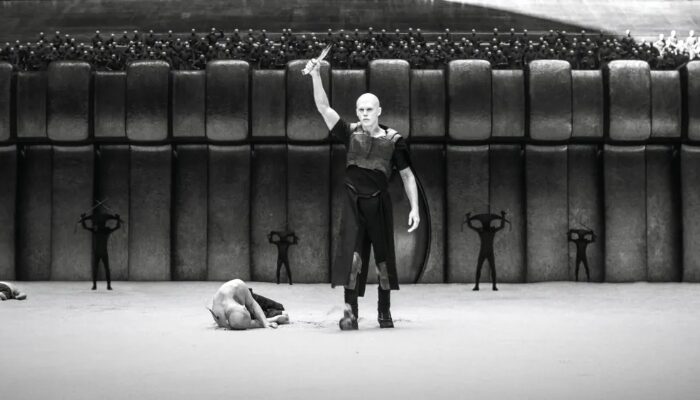
Feyd-Rautha Harkonnen (Austin Butler) is the best element of Dune: Part Two, hands down. He is the most electrifying variable in almost every scene he is in, including those with Paul Atreides (Timothée Chalamet).
Since Feyd-Rautha never says a word in the marketing materials (he is only spoken of), the viewer is not expecting the husky voice that he speaks in, a tonal replica of the baron’s growl.
The cannibal female Harkonnens were a nice twist regarding the company that Feyd keeps and the type of person he is, as is Feyd randomly killing two of his servants. His mercurial barbarism adds to his mystique, his flavor as a character, and his status as someone to be feared.
The Arena Battle
The arena battle in Dune: Part Two is the most visually inventive moment in the film. It mirrors the black-and-white scene in Kill Bill: Vol. 1, a necessity to maintain the R-rating that Quentin Tarantino desired. In Dune: Part Two‘s case, its director, Denis Villeneuve, wanted to maintain its PG-13 rating while placing as much violence into the scene as possible to convey its brutality.
The result is artistic and beautiful.
The beginning of the battle is silly: two muscular, drugged combatants get released into the arena and are slaughtered. It’s not a battle. It’s an execution; the arena a glitzy abattoir. The third combatant, undrugged Lieutenant Lanville (Roger Yuan) from Dune: Part One, is the real contestant. This is where the drama inside and outside of the arena converges, then begins to build and build, e.g., the look on Feyd’s face—”he’s not drugged.” Lanville can actually kill Feyd-Rautha Harkonnen and has the tools to do so. The acting, tension, and kinetic activity during this part of the arena fight all rise to the occasion.
If Lieutenant Lanville were well-fed and hydrated, he would put up a far better fight than the one that plays out, but like the Kingslayer after six months of captivity in George R.R. Martin‘s A Storm of Swords, Lanville does what he can with the hand he is dealt, to grand on-screen entertainment effect, and it is almost good enough to defeat his enemy.
Lady Margot Fenring’s Seduction
Like the arena battle, the Lady Margot Fenring (Léa Seydoux) seduction is handled with style and imagination, creating something that could easily be tawdry—a visual what’s-going-to-happen next moment in Dune: Part Two. The flashes of light, the play on words, the circling, all mental, all tweaked, and twinkling senior vs. sophomore gamesmanship. The scene seems like a verbal duel, but Fenring quickly shows she has (and always had) the upper hand through her Bene Gesserit training.

The Lack of Consistency with Arrakis’ Sun
In Dune: Part One, the inhabitants of Arrakis had to avoid direct and prolonged exposure to the sun of Arrakis. The sun was so hot in that film that people had to be under cover by a certain point each day. There is no sun avoidance in Dune: Part Two. It is a near completely dropped plot point and ‘character’ in the film.
This is a clear lack of consistency for plot convenience between the two films.
The Arrakis’ sun is a constraint that Dune: Part Two’s writers don’t want to deal with anymore, so Fremen sun avoidance rules and the sun’s effect get written out of the film.
Forgotten Shields (or How I Learned to Just Go With It)
Forget shields and all of the rules that apply to them from the source material in Dune: Part Two. And with those forgotten shields, why are people using knives and swords…Put those thoughts out of your mind. Your mandate is to “just go with it.” Forget those thinly-established world rules from Dune: Part One. Chew your popcorn, sip your drink, and “just go with it.”
Culture Clash
The initial cultural clashes between Fremen and Atriedes in Dune: Part Two add to the realistic patina of the film when one culture is introduced to another for the first time. The manipulation of one culture by another that is more technologically and politically savvy is even more realistic. When Lady Jessica (Rebecca Ferguson) does this and Gurney Halleck (Josh Brolin) pushes Paul Atriedes to do the same, it positively adds to the nuisance of Dune: Part Two.

Harkonnen Soldiers are the New Stormtroopers
The Harkonnen’s hunting the Fremen at the beginning of the film and using suspensors to get away from a possibly approaching worm would be a good move, if not for the human combatants in their immediate vicinity. Because of the potential threat of a worm, the Harkonnens place themselves in a kill box with no cover for 360 degrees in broad daylight.
No trained soldier would ever do this.
It seems screenwriters Denis Villeneuve and Jon Spaihts never read or watched Lone Survivor (or spoke to any active or retired soldier about live combat and how to use your environment to your advantage, e.g., using it as a shield or blending into it to camouflage yourself). When the black-clad Harkonnen “soldiers” start to get picked off by Fremen gun fire, the viewer may think, “You’re God-damn right. You’re standing up in a live combat zone with no cover. What do you expect is going to happen to you?” It’s literally shooting fish in a barrel. It’s asinine.
At its outset, it’s a cool scene with great visuals until the scene evolves and viewer thinks about it: these are grown men, veteran soldiers (an assumption), acting like greenhorns who haven’t been taught anything, just placed in armor and sent out. Maybe they are untrained newbies. Maybe that explains why they are nincompoops and needlessly expose themselves to enemy fire.
Good heroes need good villains to truly shine. When your enemy are undisciplined goofballs, that effect, that desired result, never comes into existence.
The Major and Minor Moments in Battles
The CGI for the worms in Dune: Part Two is excellent; from Paul Atriedes’ first worm ride to the Fremen using the worms as combat vehicles in the third act of the film (with flags flapping and soldiers kneeling), the worms’ look, feel, and granular tactility are all top-notch and exhilarating to behold.
Shishakli, on her knees after the destruction of Sietch Tabr and burned alive off-screen by Feyd, is a quiet moment in the film that speaks loudly, only needing dialogue in one direction. The Fremen poise under duress is on full display as Shishakli accepts her flame fate in silence. For such a strong character moment, it is a shame the viewer is not given more scenes with her in the film so that her loss is felt and not just witnessed.
The Fremen that hangs onto Glossu “Beast” Rabban (Dave Bautista)’s ornithopter after an ill-conceived and ill-executed raid is the capstone of that scene and a visual example of how undaunted Fremen are, even when thrown into a harrowing situation. All the Fremen warrior sees is Rabban—a Harkonnen, a target to be vanquished, even when lifted hundreds of feet off the ground and hanging on for dear life. It is an impressive and fanatical example of tenacity.
The Worthless Gurney Halleck vs. Glossu Rabban Fight
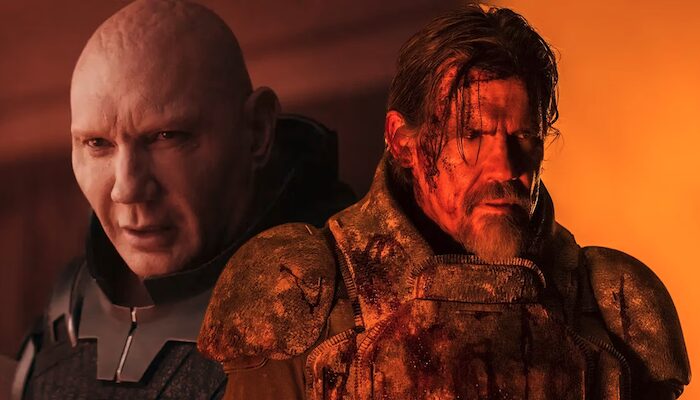
Gurney Halleck vs. Glossu Rabban is the most anticipated, worthless, throwaway fight in both of Villeneuve’s Dune films. All of the build-up: “The Harkonnens are brutal!”; all of the hate (Rabban gave Gurney his facial scar); all of the history (Gurney’s sister died in a Harkonnen Pleasure House). Pointless. Worthless. None of it is used in the Gurney vs. Rabban fight à la Luke and Darth Vader’s emotional final confrontation in Star Wars: Episode VI – Return of the Jedi.
Your mandate as a Dune: Part Two viewer: Forget about all that.
Just watch Gurney’s indignant march through the battlefield as he approaches Rabban.
Rabban is a zero as a combatant. He has no fighting skills, and he leads an army of fighting men. How does that happen, even in a fake sci-fi universe? How does he have no hand-to-hand combat training when he, and his family, are at war with another family, another house, and have been for generations? How does he have no weapons training when he was born into the aforementioned reality, with assassins around every corner? It makes no sense.
Forget about all that.
Just watch Gurney’s indignant march.
The Gurney vs. Rabban fight is completely anti-climactic and an absolute nothing. It’s a waste of screen time. It would have been better if the screenwriters had left it off-screen, like in the book. At least then, there would be no disappointment (at least not this big of a disappointment). In Dune: Part Two, when the lackluster Gurney vs. Rabban fight quickly happens and concludes, the viewer may place their hand to their head, thinking, “This can’t be real. That is their final battle?”
Just remember what is important about their five-second confrontation, Gurney and Rabban’s storylines, Rabban’s whip (spotlighted numerous times in both films), their dialogue, familial history (and tragedy), and everything else that leads to this sorry, mediocre moment…
Watch. Gurney’s. Indignant. March.
That’s all it boils down to. That’s all it was ever leading to.
The Fruitful Paul Atreides vs. Feyd-Rautha Harkonnen Fight
The fight between Paul Atreides and Feyd-Rautha Harkonnen in Dune: Part Two is very good, exciting, and surprising. Their confrontation is far more violent for a PG-13 film than the viewer may have been expecting. Violence doesn’t always make a battle scene better, but Feyd’s kinetic prowess has been built up during the entire film, as has, to a lesser extent, Paul’s fighting ability, in conjunction with his pugilistic exploits from the first film. Their clash should have been epic, and it is.
At one point, Feyd-Rautha is winning the fight and stops to talk about pets. You’re winning. Why are you stopping to talk about pets? Why give your opponent a break to collect themselves when you have them on the ropes? Why? Hubris and arrogance—the two flaws frequently bestowed upon a villain? Without a doubt. Feyd is no humble killer, and Paul, given the breather, uses it to his ultimate advantage.
Feyd’s defeat is the expected resolution, but the road to it is highly entertaining.

The Story’s Largest Flaw: Chani
Not all of the elements in Dune: Part Two work at all times. The film’s largest flaw is Chani (Zendaya). That flaw becomes more and more apparent as the film progresses, right up to her final moment on-screen.
When Chani is being instructive? Ten. When Chani is being loving, kind, or understanding? Ten. When Chani is upset, angry, or enraged? Three. The viewer doesn’t quite buy it. It is a combination of many things, but mostly it has to do with how those scenes are written.
The foundation is laid throughout the film that Chani is hot-headed when she is passionate about something, e.g., the Fremen and Paul Atreides.
When Paul ultimately betrays her for prospective peace in the empire by proposing a marriage to Princess Irulan Corrino, Chani is taken aback, grows angry, eventually turns, and leaves. In these key moments, where is Chani’s irrefutable passion? Where is fiery Chani? Where is the raised voice that Paul has used her, lied to her, betrayed her? Where is Chani getting in Paul’s face, calling him a bastard? Where is the attempt to take Paul’s life—to literally stab him in the back—the way he has just figuratively done to her? The foundation for all of this is there but isn’t utilized; it is such a pivotal moment, a third pivotal moment, built up and up to through two major combat scenes, and just when a third confrontation could occur and bloom, an emotional verbal combat scene, nothing.
Chani is respectful of the situation (a rarity given her pugnacious nature), leaves with what pride she has left, and slinks away, but to the detriment of the scene, the heightened moment, and the film. Chani’s last action in Dune: Part Two, calling a worm, is wanting, limp, and unsatisfying. The banality of it, after two pivotal battles have just occurred, is a noticeable descent from visceral heights the viewer shouldn’t have been allowed to descend from. Chani’s betrayal and heartbreak moment should have matched the two preceding battle scenes, ameliorated them, and sustained the accumulated momentum by adding to them through another intense turn of events instead of what the viewer ultimately receives—a wasted opportunity.
Closing Thoughts
Dune: Part Two is a film of ebbs, whose overall direction is upward. Villeneuve excised multiple scenes and characters out of the final cut of the movie to tighten it and strengthen what the viewer sees on-screen. Chani’s presence and prominence should have been truncated in a similar, less aggressive fashion, while fully exploiting when she is on-screen. That oversight (or directorial indulgence) notwithstanding, we are given Feyd in Dune: Part Two; we are given worms; we are given closure; and we are given new beginnings. Good enough.
Rating: 8/10
Leave your thoughts on this Dune: Part Two review and the film below in the comments section. Readers seeking to support this type of content can visit our Patreon Page and become one of FilmBook’s patrons.
Readers seeking more film reviews can visit our Movie Review Page, our Movie Review Twitter Page, and our Movie Review Facebook Page.
Want up-to-the-minute notifications? FilmBook staff members publish articles by Email, Mobile App, Google News, Feedly, Twitter, Facebook, Instagram, Tumblr, Pinterest, Reddit, Telegram, Mastodon, Flipboard, and Threads.