



![Film Review: IL CILENO: An Explosive True Story Led by a Mesmerizing Lead Performance [Locarno 2026]](https://film-book.com/wp-content/uploads/2026/08/Camilo-Arancibia-The-Chilean-01-1200x675-1.png)


Coyote vs. Acme Review
Coyote vs. ACME (2026) Film Review, a movie directed by Dave Green, written by Samy Burch, and starring Will Forte, Lana Condor, John Cena, Tone Bell, Luis Guzmán, Martha Kelly, P. J. Byrne, Eric Bauza, Kenneth Choi, Candi Milo, and Jim Cummings
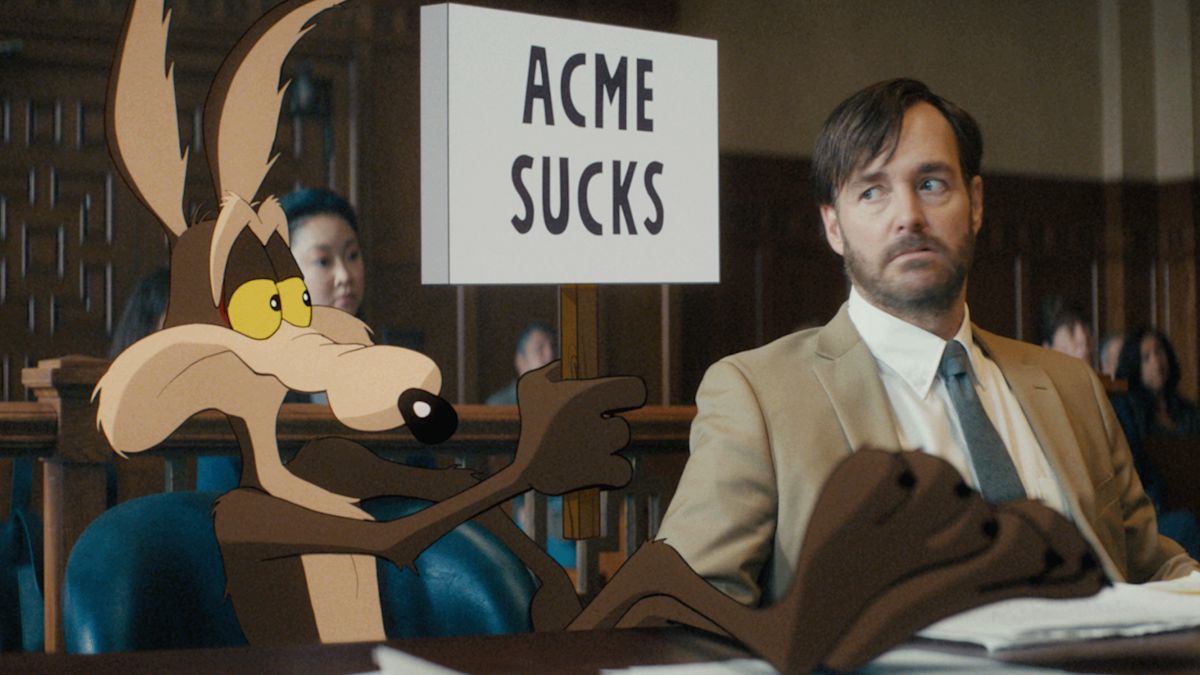
Almost three years after being shelved for a tax write-off, Coyote vs. Acme is finally getting the theatrical release it deserved. The film follows Wile E Coyote, who learns that ACME may have been selling him deliberately faulty equipment in his quest to eat the Roadrunner, and decides to go to court. Now he and his new friends must gather evidence and uncover a decades-long conspiracy to give the Coyote the justice he deserves. The movie has just as much heart as it does comedy, and it brings out the best in these legendary animated characters, even if the animation itself doesn’t always do the characters justice.
Coyote vs. Acme is, at its core, a parody and an homage to true-story legal movie dramas such as Dark Waters (2019) and Erin Brockovich (2000). It even begins with a phony, ʻinspired by true eventsʻ tagline which serves as a joke about how unfactual the events of this movie are, and how little is required for a film to say that it’s based on ʻreal events’. Like other dramas, it begins simply, but over time and through investigation, the layers and layers are peeled back to reveal a growing conspiracy that leads all the way to the top. In this case, the big evil corporation is ACME, the company that creates everything from Anvils to ray guns. Though not cartoonishly evil, ACME is, funnily enough, presented as cartoonishly realistic. Like other companies in the real world, ACME is portrayed as a powerful company that doesnʻt care about what its products do or whom it harms, because it typically settles cases on the cheap before it’s forced to change its practices and ultimately save money. There is a kind of out-of-body feeling, wild that a wacky cartoon movie has a villain plot that mirrors very closely what real-life corporations have been guilty of. Yes, it involves more cartoon bombs, goo, and falling anvils than most legal dramaʻs but it’s interesting all the same. It’s a shame, then, that it all wraps up because of a shameless use of Deus Ex Machina at the end, or, in this case, Deus Ex Rabbitta. Ending aside, it strikes the right balance between cartoon buffoonery and drama, keeping it going. Which is a tone that should have carried over flawlessly into the film’s technical side.
Getting this out of the way, but the animated cast themselves are as wacky and funny as they were when they originated in the 1940s. Eric Bauza should get full accolades for his range in pulling off the voices and performances of so many iconic characters. However, depending on the shot, it’s kind of a toss-up of how they visually interacted. Which is surprising, considering this is the same movie that gave us Space Jam (1996) and Looney Tunes Back in Action (2003), all films hampered a bit by their writing but praised for their visual quality. Here it’s the opposite: a film with celebrated writing but is held back by the visuals. Depending on the shot, the sceneʻs lighting and the subject’s angle, the character models for toons look unnatural, the character lines get scrunched up, and distinct facial features seem flat or uncanny. They are not unwatchable; many of the animation and live-action shots look very good on screen, but due to the conversion of traditional animation elements into 3D and what could be chalked up to budgetary cutbacks, we are left with some animated characters that could have looked better at certain angles. Luckily for the Coyote, most of his shots and details were handled with extra care, so his transition into 3D was smoother than Foghorn Leghorn’s (Eric Bauza), for example. Which is a shame because when the film does utilize full traditional animation, it looks phenomenal. It’s the film’s one shame that it can’t consistently maintain the clean, distinct style that Who Framed Roger Rabbit (1988) pioneered over 30 years ago. Instead, we are left with a budgeted version, which isnʻt bad but disappointing compared to what came before it.
The Coyote is a fascinating character in this film, because at no point does he ever stop being who he is at his core, a wily rascal. He is very clearly a victim of the ACME corporation, but that doesnʻt stop him from acting in his own best interests. Now this added dimension doesn’t suddenly make Coyote a deep, complicated Shakespearean character; he still tries to blow something up every time he is on screen. But his obsession with trying to catch the Road Runner while a gag also paints the Coyote in a nuanced light, showing that he isnʻt a perfect victim. That despite the fact that he acts against his self-interest a lot of the time, what has happened to him is still wrong. Coyote vs. Acme walks a line, showing how the Coyoteʻs pursuit of the Roadrunner is both admirable and self-destructive, in both comedic and detrimental ways. This is where Kevin Avery (Will Forte) comes in as Coyoteʻs foil. As a defeated lawyer who is burnt out by always failing to win big in his cases, so he settled for a life of settling cases and not fighting back against big odds. Avery is a fun character; he is a man used to seeing and interacting with toons when things blow up in their faces (sometimes literally), and even he is tired of The Coyotes’ shenanigans. At the beginning of the film, both of their outlooks and lifestyles are unhealthy and self-destructive, and over the course of the film, they open eachotherʻs eyes to how their methods and these outlooks cause harm not only to themselves but also to the people and toons around them. Not a complete 180, the Coyote is never going to stop being the Coyote, but there is a new approach, a new way he sees his life.


Despite its occasional visual shortcomings, Coyote vs. Acme is a surprisingly human story. In so many ways, the audience sees themselves in the Coyote and how our everyday lives and mental health issues are hijacked by those whose only interest is making money. How easy it is to surrender the mundanity of everyday life. How, despite it all, we can still move forward and find a way to make life better by being smart, persevering, and finding strength in others when you start to wither. It’s a nice parallel to the movie’s real-world troubles, and now that it persevered and made it through, we are all better for it.
Rating: 8/10
Leave your thoughts on this Coyote vs Acme review and the film below in the comments section. Readers seeking to support this type of content can visit our Patreon Page and become one of FilmBook’s patrons.
Readers seeking more film reviews can visit our Movie Review Page, our Movie Review Twitter Page, and our Movie Review Facebook Page.
Want up-to-the-minute notifications? FilmBook staff members publish articles by Email, Mobile App, Google News, Apple News, Feedly, Twitter, Facebook, Instagram, Tumblr, Pinterest, Reddit, Telegram, Mastodon,
Related Articles