





Film Review: THE LOVE THAT REMAINS: A Dog Named Panda Steals Scenes in This Drama-Heavy Film From Iceland [NYFF 2025]

The Love That Remains Review
The Love That Remains (2025) Film Review from the 63rd Annual New York Film Festival, a movie written and directed by Hlynur Pálmason and starring Sverrir Gudnason, Saga Garðarsdóttir, Ída Mekkín Hlynsdóttir, Ingvar Sigurdsson, Grímur Hlynsson, Anders Mossling, Panda, Þorgils Hlynsson and Halldór Laxness Halldórsson.
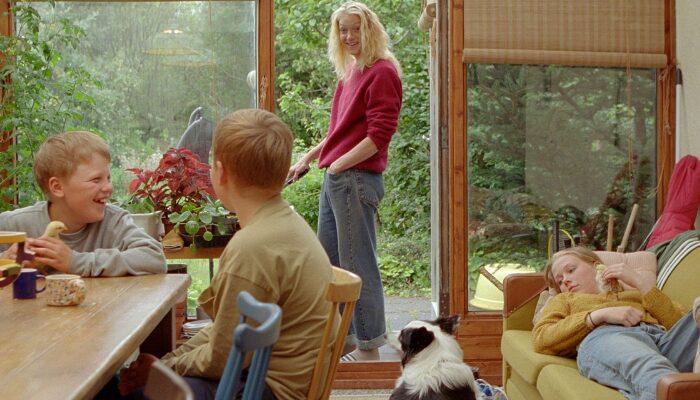
One of the most ambitious and ambiguous films at this year’s New York Film Festival is Icelandic filmmaker Hlynur Pálmason’s disturbing mediation on life, The Love That Remains. While the film steers a lot towards negativity under close analysis and certainly has a few depressing plot revelations, the story is undoubtedly fascinating to watch unfold as the picture offers very little predictability and a whole lot of picturesque scenery which is enhanced by the presence of a very charismatic fur ball of a dog called Panda who steals so many scenes in the picture, one could consider him a true supporting performer in the proceedings.
This film offers several discussions about sex by the characters featured in it. Whether the married couple in the film is doing it or not, the last time they’ve done it, etc. Children (played perfectly by Ída Mekkín Hlynsdóttir, Grímur Hlynsson and Þorgils Hlynsson) uncomfortably discuss sex, but that’s what makes watching the movie feel like one is immersed with real people rather than cardboard cutouts. These young kids talk about the meaning of life and one of the young boys feels he wants to be happy with a girl rather than have sex with her. These scenes are a way to create scenarios where all the characters have very specific viewpoints on life which manifest themselves in a couple of key ways throughout the paper thin, but heavily symbolic, plot. The kids wonder whether their parents are happy and the answers the picture presents suggest they are probably not.
There is a very memorable shot of the female star of the film, Saga Garðarsdóttir, who plays Anna, a would-be successful artist stuck in a marriage with her more grounded husband, Magnús (Sverrir Gudnason), who typically goes off to sea to work in order to feed his family. That union the couple has formed is in a rut despite the fact the pair have several children together. This aforementioned noteworthy scene is shot underneath Anna’s dress as she stands surrounding another person in the sun and we see an upwards shot of her which could signify many things, perhaps her powerful influence over her family above all else.
Yes, this is a film chock full of heavy-handed symbolism such as when an oversize rooster appears on-screen. You see, Magnús spends some time trying to go after a rooster so when the tables are turned during a scene which is fantasy-like in scope, the results are awe-inspiring. Heck, the monster from The Creature from the Black Lagoon even appears to warn us that not everything we want in life is what we get. There are bows and arrows galore as one of the boys gets shot with an arrow which has to be removed in a hospital in a frightening part of the picture later in.
![Film Review: CLUB KID: A Movie That's as Messy as Real Life and as Entertaining as Indie Films Come [NYFF 2026]](https://film-book.com/wp-content/uploads/2026/10/Jordan-Firstman-Club-Kid-01-1200x675-1-220x150.png)
![Film Review: 14TH: Ava DuVernay's Bold Film is an Incredible Accomplishment [NYFF 2026]](https://film-book.com/wp-content/uploads/2026/10/14th-1-1200x675-1-220x150.png)
There are also arrows which are shot and punctured into what seems to be a knight in the form of a scarecrow, but the direction of these scenes gets more startling when we realize that the knight/scarecrow could be a metaphor for a real person. Could these arrows that are graphically shot deep into the knight represent the physical suffering of this married couple the film portrays? It’s a good possibility although nothing is what it seems to be in this movie. There are some vivid moments, but it would take a second viewing to get through the real events that occur and compare them to the symbolism which gets so heavy, audiences could fall over their seats in confusion and throw up their arms at given intervals.
Anders Mossling, as Martin, a would-be supporter of Anna’s work has a great scene with Anna where he discusses realities of life which take him off the topic of her art and more on the concept of the human condition and all its unsolved mysteries. Martin doesn’t have a big role, but it is a significant one in terms of what the dialogue represents in the bigger picture which is part of the sad story’s lesson that it has to share with viewers.
All the cast members that play the people who comprise the family are solid. Sverrir Gudnason’s character, in particular, feels like he is going through the hardest time of his life and it often feels he is losing the battle in life despite all the hard work he puts in. Saga Garðarsdóttir is a reliable performer who handles her difficult role with exquisite sensitivity and one feels for both the characters of the husband and the wife whose relationship is falling into an abyss which could be properly represented by the black lagoon itself, among other things.
Hlynur Pálmason doesn’t sugarcoat anything here, except perhaps how cute Panda the dog is, but Panda gets to light up the screen in a “performance” that has already received countless accolades and stirred up conversations I’ve eavesdropped on here at the New York Film Festival.
It’s hard to recommend The Love That Remains, but I’m going to do it. You may as well consider it a shoo-in for a considerable amount of votes for this year’s Best International Film although it may be too dark, ultimately, to make the final cut. Panda may be a ray of sunshine, but that’s as bright as this movie gets, thematically speaking. That darkness about life and about marriage which the film presents can open up discussions, though, and those are the types of conversations that often make life worth living and are demonstrative of “the love that remains” in life after the sorrow. It’s an interesting film.
Rating: 7/10
Leave your thoughts on this The Love That Remains review and the film below in the comments section. Readers seeking to support this type of content can visit our Patreon Page and become one of FilmBook’s patrons.
Readers seeking more New York Film Festival news can visit our New York Film Festival Page, our Film Festival Page, and our Film Festival Facebook Page.
Readers seeking more film reviews can visit our Movie Review Page, our Movie Review Twitter Page, and our Movie Review Facebook Page.
Want up-to-the-minute notifications? FilmBook staff members publish articles by Email, Mobile App, Google News, Apple News, Feedly, Twitter, Faceboo
Related Articles
![Film Review: CLUB KID: A Movie That's as Messy as Real Life and as Entertaining as Indie Films Come [NYFF 2026]](https://film-book.com/wp-content/uploads/2026/10/Jordan-Firstman-Club-Kid-01-1200x675-1-700x394.png)
![Film Review: 14TH: Ava DuVernay's Bold Film is an Incredible Accomplishment [NYFF 2026]](https://film-book.com/wp-content/uploads/2026/10/14th-1-1200x675-1-700x394.png)
![Film Review: THE DEBUT: Jesse Eisenberg's Look at Method Acting is Absolutely Perfect [NYFF 2026]](https://film-book.com/wp-content/uploads/2026/10/Julianne-Moore-The-Debut-01-1200x675-1-700x394.png)
![Film Review: BEHEMOTH!: Pedro Pascal is Great in a Truly Original, Often Successful, Film [NYFF 2026]](https://film-book.com/wp-content/uploads/2026/10/Pedro-Pascal-Behemoth-02-1200x675-1-700x394.png)
![Film Review: A STATEMENT: Tom McCarthy's Star-Studded Drama is Enjoyable Enough Despite Some Minor Flaws [NYFF 2026]](https://film-book.com/wp-content/uploads/2026/10/Paul-Giamatti-plus-co-A-Statement-01-1200x675-1-700x394.png)
![Film Review: THE REMOTES: Technology Can Be Wicked in This Frightening Cautionary Tale [NYFF 2026]](https://film-book.com/wp-content/uploads/2026/10/The-Remotes-01-1200x675-1-700x394.png)
