![Film Review: THE DEBUT: Jesse Eisenberg's Look at Method Acting is Absolutely Perfect [NYFF 2026]](https://film-book.com/wp-content/uploads/2026/10/Julianne-Moore-The-Debut-01-1200x675-1.png)




![TV Review: THE PITT: Season 2, Episode 12: 6:00 P.M. [HBO Max]](https://film-book.com/wp-content/uploads/2026/05/katherine-lanasa-the-pitt-season-2-episode-12-600pm.jpg "Tv Review: The Pitt: Season 2, Episode 12: 6:00 P.m. [hbo Max]")
The Pitt Season 2 6:00 P.M. Review
HBO Max’s The Pitt: Season 2, Episode 12: 6:00 P.M. TV Show Review. The Pitt’s twelfth episode, “6:00 P.M.”, operates like a pressure valve that never quite releases. Instead of offering relief after the chaos of earlier episodes, it tightens the screws both emotionally and clinically on every character still standing in Pittsburgh Trauma Medical Center’s overwhelmed emergency department. What makes this episode stand out is not just its relentless pacing, but how it layers human fragility beneath clinical urgency, forcing both the characters and the audience to confront what endurance really costs.
From the opening moments, where a violent patient assault spirals into ethical conflict, the episode establishes its central tension: survival versus protocol. Dana Evans (Katherine LaNasa) makes the split-second decision to sedate an attacker mid-assault, saving Emma while creating a medical and legal grey area that ripples through the entire episode. Michael “Robby” Robinavitch (Noah Wyle) pushes back, and his reaction is not just about rules. It reflects control slipping away in a department already close to collapse. Their confrontation, particularly as Robby questions Dana’s use of Versed after the attack, highlights one of The Pitt’s strongest recurring themes. When systems fail, individuals are forced to act and then justify those actions afterward.
This ethical tension is mirrored in the episodes major medical case involving Oliver, a dialysis patient in acute respiratory distress after missing treatment. Under Robby’s leadership, the team moves quickly as his condition escalates into flash pulmonary edema. The use of high-dose nitrates alongside phlebotomy as a temporary measure is both confronting and grounded in clinical logic. This is The Pitt at its best, using medicine not just as spectacle but as a way to explore desperation and ingenuity under pressure.
At the same time, the episode balances high stakes procedures with quieter and more emotionally devastating storylines. The elderly couple, Frida and Eddie, represent a different kind of emergency, one that cannot be solved with a single intervention. Samira (Supriya Ganesh) attempts to guide them toward safer care options, particularly assisted living, but meets resistance rooted in pride and fear of losing independence. The show avoids easy answers. Instead, it presents aging as a slow negotiation between dignity and reality, making their storyline just as tense as any trauma case.
Meanwhile, the fallout from the earlier assault continues to unfold through Emma and Curtis, the attacker. Dr. McKay (Fiona Dourif) delivers one of the episode’s most grounded moments, explaining that intoxication does not remove accountability, even after learning his behaviour may have been influenced by cocaethylene. Justice here feels complicated and often unsatisfying, reflecting real-world consequences.

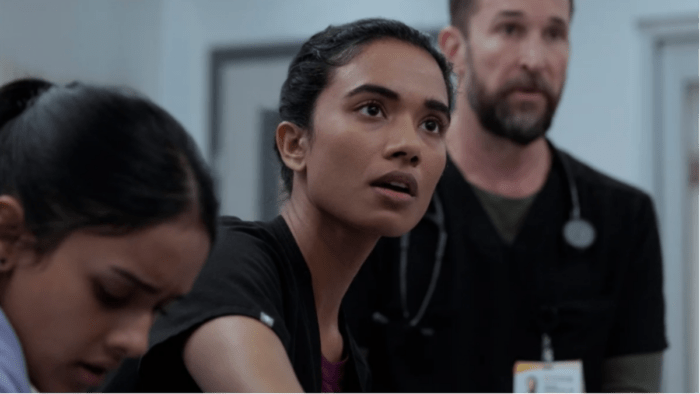
The episode’s most intense sequence comes when Dante, initially stabilised after a fireworks explosion, suddenly crashes. As his blood pressure drops, Dr. Santos (Isa Briones) identifies cardiac tamponade, forcing an emergency pericardiocentesis in the trauma bay. The shift from stable to critical happens in seconds, reinforcing how unpredictable trauma medicine can be. The procedure is gripping in its precision and urgency, and marks a key turning point for Santos, who steps up under pressure and proves she is no longer the uncertain newcomer but a doctor capable of decisive action.
Beyond the medical drama, “6:00 P.M.” explores the emotional toll of working in such an environment. McKay’s quiet breakdown, and her admission that she cannot remember the last time she cried after witnessing a patient’s death, captures the psychological cost of repeated exposure to trauma. Dr. Langdon (Patrick Ball), in a rare moment of restraint, encourages her to confront those emotions rather than suppress them, adding further depth to his character. The show continues to present burnout as something lived rather than simply discussed.
Santos’ storyline reinforces this idea. Her frustration toward Langdon, particularly as she recounts how he previously undermined her confidence, reveals how workplace relationships can be just as exhausting as clinical pressure. Her conversation with Whitaker (Gerran Howell) exposes the tension beneath her confidence, showing that professional competence does not always mean emotional stability.
Robby’s arc ties everything together. His planned departure hangs over the episode, turning routine decisions into something more significant. His confrontation with Dana over control and responsibility anchors the episode’s emotional core. Robby is not just struggling to leave. He is struggling with the idea that he may not be essential. It is a subtle but powerful exploration of identity, especially for someone whose purpose is tied so closely to his work.
The episode also touches on wider systemic issues, particularly through references to rural hospital closures and cyberattacks disrupting healthcare infrastructure. These elements ground the story in real-world challenges, reminding viewers that the chaos inside Pittsburgh Trauma Medical Center is part of a larger and fragile system.
What makes “6:00 P.M.” especially effective is its lack of resolution. Patients stabilise, but problems remain. Conflicts are acknowledged, but not resolved. Even the arrival of the night shift feels less like relief and more like continuation. The emergency department does not reset. It simply carries on.
The performances remain strong across the board. The dynamic between Robby and Dana, especially during their confrontation over the assault, anchors the episode, while Santos and McKay deliver some of the most emotionally impactful moments. Each character feels distinct, even within a crowded narrative.
If there is a drawback, it is that the number of storylines can feel overwhelming at times. However, this reflects the constant overload of an emergency department. The chaos is not only shown, but also felt.
Ultimately, “6:00 P.M.” stands as one of the strongest episodes of the season. It does not rely on escalation alone but instead deepens its emotional and ethical weight. The episode understands that the real stakes extend beyond life and death. They lie in the consequences that remain after the immediate crisis has passed.
In a series defined by intensity, this episode shows that The Pitt is not just about surviving the shift. It is about what remains afterward.
Leave your thoughts on this The Pitt: Season 2, Episode 12: 6:00 P.M. review and the film below in the comments section. Readers seeking to support this type of content can visit our Patreon Page and become one of FilmBook’s patrons.
Readers seeking more The Pitt reviews can visit our The Pitt Page.
Readers seeking more HBO Max articles can visit our HBO Max Page, our HBO Max Twitter Page, and our HBO Max Facebook Page.
Readers seeking more TV show reviews can visit our TV Show Review Page, our TV Show Review Twitter Page, and our TV Show Review Facebook Page.
Want up-to-the-minute notifications? FilmBook staff members publish articles by Email, Mobile App, Google News, Apple News, Feedly, Twitter, Facebook, Instagram, Tumblr, Pinterest, Reddit, Telegram, Mastodon, Flipboard, Bluesky, and Threads.
Related Articles