![Film Review: THE DEBUT: Jesse Eisenberg's Look at Method Acting is Absolutely Perfect [NYFF 2026]](https://film-book.com/wp-content/uploads/2026/10/Julianne-Moore-The-Debut-01-1200x675-1.png)




![TV Review: THE PITT: Season 2, Episode 13: 7:00 P.M. [HBO Max]](https://film-book.com/wp-content/uploads/2026/06/patrick-ball-amielynn-abellera-the-pitt-season-2-episode-13-700pm.jpg "Tv Review: The Pitt: Season 2, Episode 13: 7:00 P.m. [hbo Max]")
The Pitt Season 2 7:00 P.M. Review
HBO Max’s The Pitt: Season 2, Episode 13: 7:00 P.M. TV Show Review. The Pitt’s thirteenth episode, ‘7:00 P.M.’, is one of the show’s most effective hours, shifting from pure crisis into consequence. Where previous episodes thrived on urgency, this hour is defined by what lingers after the chaos. The emergency department is still overwhelmed, but the focus turns inward. Decisions made earlier in the day begin to settle, exposing the emotional and systemic fractures that the staff can no longer ignore.
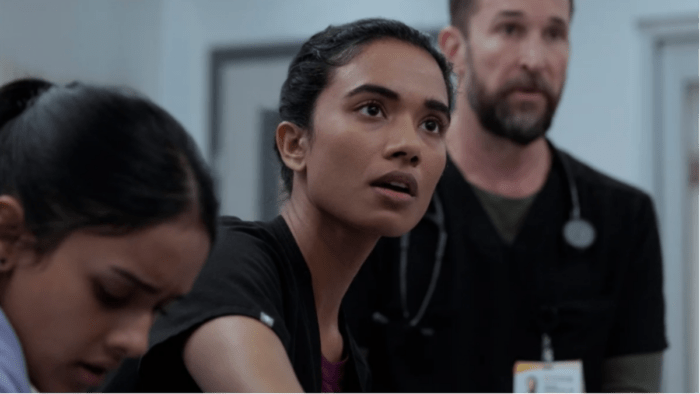
The episode opens with Orlando Diaz’s (William Guirola) return, now critically injured after leaving the hospital against medical advice. Dr. Samira Mohan (Supriya Ganesh) is forced to confront the consequences of that earlier decision as his condition rapidly deteriorates. The case escalates into severe traumatic brain injury, with clear signs of increased intracranial pressure, forcing immediate intervention. The introduction of Dr. Conley (Mary McCormack), the Chief of Neurosurgery, and the decision to perform an external ventricular drain at the bedside becomes one of the episode’s defining sequences. It is not framed as a heroic moment, which is exactly why it works. The clinical precision is matched by emotional weight, particularly as Samira struggles to stay focused while facing the reality of what Orlando’s outcome may be.
That tension carries into one of the episode’s most powerful interactions when Orlando’s wife arrives. Her question is simple. Will he wake up? The answer is not. Robby and Samira explain the possible outcomes with clinical honesty, ranging from long-term disability to permanent care. The scene lands because it avoids sentimentality. Instead, it highlights the gap between medical possibility and personal expectation. It is a moment that reinforces one of the show’s central ideas. Survival is not always the same as recovery.
Michael “Robby” Robinavitch (Noah Wyle) continues to unravel across the episode, and his storyline becomes the emotional backbone of the hour. His inability to leave at the end of his shift is no longer about responsibility. It is about control. His frustration with Dana Evans (Katherine LaNasa) escalates into a confrontation that exposes how deeply he is struggling. He questions her judgement, criticises his team, and fixates on everything that could go wrong in his absence. What makes this arc so effective is that it never feels like a sudden breakdown. It feels earned. Robby is a character who has carried the weight of the department for too long, and now that he is about to step away, he cannot let go.
Dana provides the necessary counterbalance. Her insistence that Robby step away is not just practical. It is emotional. She recognises that his behaviour is no longer helping the team. Their argument is one of the episode’s strongest scenes because it is rooted in mutual understanding rather than conflict alone. When Dana tells him to leave and trust the team, it becomes clear that leadership in this environment is not about control. It is about knowing when to step back.
![TV Review: THE PITT: Season 2, Episode 12: 6:00 P.M. [HBO Max]](https://film-book.com/wp-content/uploads/2026/05/katherine-lanasa-the-pitt-season-2-episode-12-600pm-220x150.jpg)

The episode also continues to explore the ripple effects of earlier events, particularly through the fallout of Jesse’s arrest. The staff discussion about ICE and the uncertainty surrounding his situation adds another layer of tension, grounding the episode in real-world systems that extend beyond the hospital. These moments are not overexplained, but they are present enough to shape the atmosphere of the department.
Dr. Frank Langdon (Patrick Ball) delivers one of the episode’s most human moments. After nearly intubating a patient unnecessarily, he begins to question whether he is ready to be back. His self-doubt is quiet but significant, especially when contrasted with Mel’s (Taylor Dearden) reassurance. Their conversation avoids dramatics and instead focuses on something more familiar. The fear of making the wrong decision. It is a reminder that even experienced doctors carry uncertainty, and that confidence in this environment is often fragile.
That uncertainty is mirrored in the paediatric asthma case, which becomes one of the episode’s most intense medical sequences. As the patient deteriorates, the team prepares for intubation, only to discover a pneumothorax instead. The rapid shift in diagnosis is one of the episode’s most effective sequences, highlighting the unpredictability of emergency medicine. More importantly, it reinforces the importance of reassessment. The resolution of the case is not framed as a victory, but as a narrow escape, underscoring how easily the outcome could have been different.
Dr. Santos (Isa Briones) provides a different kind of tension through her diagnostic instincts. Her identification of turmeric-induced liver injury in a patient who believed she was making healthy choices adds a sharp, almost cynical edge to the episode. The scene works because it reflects a broader issue. Misinformation in healthcare is not just inconvenient. It is dangerous. Santos’ bluntness may be abrasive, but it is rooted in accuracy, making her perspective difficult to dismiss.
The episode also finds time for quieter, character-driven moments. Dana’s interaction with Digby, helping him clean up and reconnect with a sense of identity, stands out for its warmth. It contrasts with the clinical intensity of the rest of the episode and reinforces the idea that care extends beyond treatment. These smaller moments prevent the episode from becoming emotionally one-note.
Another key storyline involves Duke, whose CT scan reveals a life-threatening aortic aneurysm. Robby’s reaction is immediate and personal. This is not just another patient. It is someone he knows. The tension here does not come from the diagnosis itself, but from the system’s inability to respond quickly. The delay in surgical intervention due to administrative barriers adds a layer of frustration that feels all too real. It becomes one of the episode’s most frustrating and effective examples of how systemic limitations directly impact patient outcomes.
By the end of the episode, there is no real resolution. Patients stabilized, but their futures remain uncertain. Staff members finish their shifts, but the emotional weight carries forward. Even Robby’s final moments suggest that leaving may not bring the relief he expects. Instead, it raises a larger question. What happens when the person holding everything together finally steps away?
The performances remain consistently strong. Noah Wyle anchors the episode with a portrayal of quiet deterioration, while Supriya Ganesh delivers a measured and emotionally grounded performance as Samira. Katherine LaNasa continues to provide stability, and Patrick Ball brings subtle vulnerability to Langdon’s arc. Each performance contributes to a sense of realism that defines the series.
If there is a limitation, it is the density of storylines competing for attention. However, this reflects the reality the show is portraying. An emergency department does not pause to focus on a single narrative. It moves forward, regardless of whether the people inside it are ready.
Ultimately, ‘7:00 P.M.’ stands as one of the season’s strongest episodes, not because of its crisis, but because of its aftermath. It examines what remains when the immediate danger passes and forces its characters to confront the consequences of their decisions. In doing so, it reinforces what The Pitt does best. It shows that the hardest part of medicine is not always saving lives. It is living with what happens after.
Leave your thoughts on this The Pitt: Season 2, Episode 13: 7:00 P.M. review and the film below in the comments section. Readers seeking to support this type of content can visit our Patreon Page and become one of FilmBook’s patrons.
Readers seeking more TV show reviews can visit our TV Show Review Page, our TV Show Review Twitter Page, and our TV Show Review Facebook Page.
Want up-to-the-minute notifications? FilmBook staff members publish articles by Email, Mobile App, Google News, Apple News, Feedly, Twitter, Facebook, Instagram, Tumblr, Pinterest, Reddit, Telegram, Mastodon, Flipboard, Bluesky, and Threads.
Related Articles
![TV Review: THE PITT: Season 2, Episode 12: 6:00 P.M. [HBO Max]](https://film-book.com/wp-content/uploads/2026/05/katherine-lanasa-the-pitt-season-2-episode-12-600pm-700x394.jpg)